

You step into the shower after a long, hazy August day in the East Bay, expecting a rush of hot water, but instead, you get a lukewarm spray that quickly turns cold. Or perhaps you try to run a load of laundry, and the machine stalls, waiting for hot water that never arrives. You head outside to check your tankless water heater, only to find it displaying a blinking error code. It was working perfectly yesterday. As a plumbing specialist with over 14 years of experience in Berkeley and the surrounding communities, I can tell you this scenario is incredibly common during wildfire season. The culprit might not be a major internal failure, but something far more subtle accumulating on the outside of your home: wildfire ash.
Late summer and early fall bring an unfortunate reality to our beautiful region - smoke-filled skies. This smoke carries fine, abrasive ash that settles on everything, including the critical air intake and exhaust vents of your on-demand water heater. Before you assume the worst, let's explore how this seasonal issue can affect your system and what you can do about it.
Common Signs and Symptoms
When a tankless water heater is starved for air, it can't operate correctly or safely. Our technicians are frequently dispatched to address issues that homeowners don't realize are related to air quality. These are the most common wildfire ash water heater symptoms we encounter:
- Intermittent Hot Water (or "Short-Cycling"): Does your water get hot for a minute, then go cold, then heat up again? This is a classic sign of an airflow problem. The unit ignites, but its sensors detect improper combustion due to a lack of oxygen. As a safety measure, it shuts down. Once the chamber clears, it may try to ignite again, leading to this frustrating cycle.
- Complete Loss of Hot Water: In more severe cases, the blockage is so significant that the unit's safety protocols prevent it from igniting at all. It will try, fail, and then lock out, leaving you with no hot water until the issue is resolved.
- Error Codes on the Display: This is one of the most direct clues. While codes vary by manufacturer, we often see tankless error codes after smoke that point specifically to "ignition failure," "flame failure," or "blockage detected." These codes are the unit's way of telling you that its combustion process is compromised. It’s a built-in safety feature that is doing its job correctly.
- Unusual Noises During Startup: You might hear a 'whooshing' or rumbling sound that is louder than normal as the unit's fan struggles to pull in enough air through a clogged screen. It may also make several clicking sounds as the igniter tries repeatedly to start the burner without success.
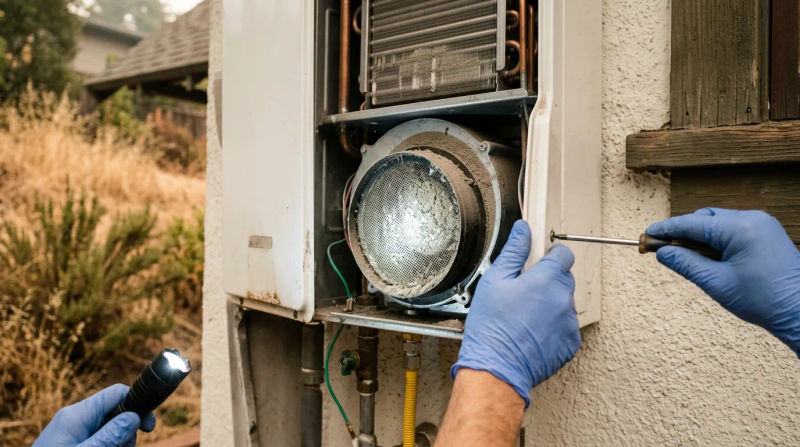
- Visible Ash Around Vents: Take a look at your unit's exterior intake and exhaust terminations. You may see a fine, grayish-white powder coating the screens or the wall around them. This is a tell-tale sign that airborne particulates are the likely source of your problem.
What Causes This Problem
To understand the problem, it helps to understand how your water heater works. A tankless water heater is a sophisticated piece of equipment that functions like a finely-tuned engine. To heat water instantly, it must burn fuel (natural gas or propane) with a precise amount of oxygen drawn from the surrounding air. This air is pulled into the unit through a screened intake vent.
During the Bay Area's fire season, the air becomes saturated with fine ash and other particulates. These particles are drawn directly toward your unit's air intake. The intake screen, designed to keep out insects and larger debris, quickly becomes clogged with this fine, dense layer of ash. This effectively suffocates the appliance.
The unit's internal computer, or control board, constantly monitors airflow and combustion. When it detects that the air-to-fuel ratio is off, it immediately shuts down the burner. This isn't a defect; it's a critical safety feature designed to prevent the production of dangerous levels of carbon monoxide and protect the internal components from damage.
In our experience across the East Bay, this issue is particularly prevalent in certain types of homes. For instance, in neighborhoods like Walnut Creek with many 1950s-era Ranch-style homes, tankless units are often installed in the narrow side-yards. These tighter spaces can have less natural air circulation, allowing smoke and ash to linger and settle more densely on intake vents. Proper and regular East Bay tankless intake cleaning becomes even more critical in these environments.
When to Call a Professional
Seeing an error code can be alarming, but not every situation requires an immediate service call. Here’s how our specialists advise homeowners to assess the situation.
What you can safely check yourself:
- Visual Inspection: Carefully inspect the exterior intake and exhaust vents. If you see a visible layer of ash on the outer screen, it's a strong indicator of the problem.
- Gentle Exterior Cleaning: You can use a soft-bristled brush or a dry cloth to gently wipe away ash from the exterior of the intake screen. Do not use water, as this can turn the ash into a sludge that is harder to remove. Never poke anything through the screen or attempt to open the unit's cover.
If a gentle external cleaning resolves the issue, you've likely found the culprit. However, this is often just a temporary fix.
When you absolutely need a professional:
- If the Problem Persists: If cleaning the outer screen doesn't restore function, it means the blockage is likely deeper inside the unit - on the internal air filter, the fan blades, or even within the burner assembly itself.
- If You Have an Error Code: While the code points to an airflow issue, it takes a trained technician to properly diagnose the cause and reset the unit safely. Simply clearing the code without fixing the underlying blockage will only cause it to return.
- For a Thorough Cleaning: A true maintenance service involves more than wiping off a screen. Our crews follow a standardized workflow. We shut off the power and gas, open the unit, and carefully clean the internal air filter, fan assembly, and burner chamber. We inspect sensors and gaskets to ensure everything is in perfect working order before reassembling and testing the unit. This comprehensive service is what ensures reliability and safety.
- Annual Maintenance: The best solution is prevention. We recommend a full professional maintenance service annually, ideally just before the fire season begins. This ensures your tankless water heater is clean, efficient, and ready to handle whatever the air throws at it.
Conclusion
Living in the East Bay means adapting to seasonal challenges like wildfire smoke. For homeowners with a tankless water heater, this includes being aware of how airborne ash can impact the system's performance. Symptoms like intermittent hot water, unusual noises, and specific error codes are often the first signs that your unit is struggling for air.
While a simple exterior inspection is something you can do, a lasting solution often requires a deeper, professional cleaning to ensure all internal components are free of debris. Acting proactively and scheduling regular maintenance can prevent you from being caught by surprise with a cold shower during an already stressful time. Don't wait for a complete failure to address the subtle signs.
If you notice any of these signs, contact a local Plumbing professional for an inspection.